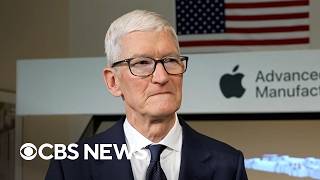
Tim Cook
tim cook guards his own screen time while handing off apple's chip crisis to his successor
Timothy Donald Cook (born November 1, 1960) is an American business executive who has served as the chief executive officer (CEO) of Apple since 2011. He had previously been the company's chief operating officer under its co-founder Steve Jobs. Cook joined Apple in March 1998 as a senior vice president for worldwide… wikipedia →
12-month trajectory
interviews & talks

Tim Cook on his legacy: "I hope that people say I was a good and decent man"

Extended interview: Tim Cook

Apple CEO Tim Cook on company's "holy grail," taking risks and more | Extended Interviews

Apple CEO Tim Cook on How Steve Jobs Recruited Him and More | The Job Interview

Talking Tech and AI with Tim Cook!
recent news
tim cook legacy and reflection
- Can Apple’s new engineer-CEO master the China balancing act? - ThinkChina
- Tim Cook's Final Earnings Call as Apple CEO Came the Same Week Apple Hit a $5 Trillion Market Cap. Here's What Investors Should Watch Under His Successor. - AOL.com
- Why does Wall Street hate Apple now? - Macworld
+ 10 more
tim cook final earnings call
- Tim Cook's Final Earnings Call as Apple CEO Came the Same Week Apple Hit a $5 Trillion Market Cap. Here's What Investors Should Watch Under His Successor. - The Motley Fool
- Tim Cook's Final Earnings Call as Apple CEO Came the Same Week Apple Hit a $5 Trillion Market Cap. Here's What Investors Should Watch Under His Successor. - Yahoo Finance
- Apple to donate to Indonesia earthquake relief efforts - The Mac Observer
+ 9 more
us manufacturing expansion
- September 1 to Mark the End of an Era at Apple - MacRumors
- Cook teases revitalization of US manufacturing ghost towns - AppleInsider
- Apple's Tim Cook exits as CEO, leaving a $416B revenue legacy and strong customer loyalty behind. - Pluang
+ 7 more
apple leadership succession
- Will Tim Cook’s Apple legacy be overshadowed by China concerns? - The Times
- Jim Cramer doubles down on Tim Cook and Apple verdict - Yahoo Finance Singapore
- Texas Mac Mini Factory Tour - Rutland Herald
+ 1 more
apple business and strategy
- VOTE: Do you think big tech companies are politically biased? - KDBC
- Apple (NASDAQ: AAPL) App Store Commission Revenue Falls 18% As Legal Battles Threaten Services Crown Jewel - foreignpolicyjournal.com
- Tim Cook's Final Apple Earnings Call Coincided With a $5 Trillion Valuation. Here's What Comes Next for John Ternus - finance.biggo.com
+ 12 more
tech industry comparisons
dispatch
Memory Becomes Apple's Supply Chain Crisis
Tim Cook is the industrial engineer who turned Apple's supply chain into its quietest weapon — the operator who took over from Steve Jobs in 2011 and then made the audacious bet to design Apple's own chips instead of buying Intel's. His career is a study in controlling your inputs by owning them, which is exactly why the crisis he hands his successor stings: a memory-price shock, driven by AI's appetite for DRAM, that no supply-chain wizardry can fully engineer around. The takeaway for a CTO is blunt — memory, not just GPUs, is becoming the constraint that sets your cost of building, and it sits in the hands of three suppliers.
The story starts in Robertsdale, Alabama, a small town near the Gulf coast. Tim Cook grows up there, the son of a shipyard worker. He is a careful, methodical kid, and by the time he leaves for college he already knows what he wants to study. He goes to Auburn University and graduates in 1982 with a degree in industrial engineering.
Hold on to that phrase — industrial engineering. It's the discipline of making a system run without waste. You find the bottleneck, you shave the time and the cost out of a process, and you keep going until the whole thing flows. That's not a footnote in this story. That's the whole man.
After Auburn, Cook goes to work for IBM, and he stays there for twelve years, from 1982 to 1994. He earns an MBA from Duke at night, finishing in 1988. By the end of his IBM run, his job is director of North American fulfillment — logistics, the plumbing of a computer business. Then come two shorter stops. He's chief operating officer of the reseller division at a company called Intelligent Electronics, and then a vice president at Compaq, which at that moment is the biggest maker of personal computers in the world.
And then, in early 1998, Steve Jobs calls.
Now, you have to understand what Apple is in 1998. It is not the company you know. Apple is on the verge of collapse when Jobs returns to it in 1997. It is months from running out of road. Cook, meanwhile, has been at Compaq for only about six months, at the top of the industry, with every reason to stay. Every rational person tells him to stay. He takes the Apple job anyway. In March 1998 he joins Apple as senior vice president of worldwide operations.
And here is where the industrial engineer goes to work.
Cook looks at Apple's factories and warehouses and sees waste in every corner. So he rebuilds the physical company. He moves the manufacturing of Apple products out of Apple's own factories and into outside contractors. He goes after inventory like it's a personal enemy. He calls inventory "fundamentally evil," and he compares Apple to a dairy — the idea being that the product should be sold while it's fresh, before it goes bad on the shelf. He drives the time it takes Apple's inventory to turn over down from months to days.
Think about what that does to a business. When your products are things people already want, and your supply chain is that lean, you can hold your prices high and keep your costs low at the same time. That gap — that's the money. That's the machine humming underneath every shiny keynote.
Cook keeps rising. In 2000 he becomes senior vice president of worldwide operations, sales, and support; in 2002, executive vice president of worldwide operations and sales. In 2004 he steps in as interim chief executive and runs the Macintosh division while Jobs takes a medical leave. And then, in August 2011, Jobs resigns, and Tim Cook becomes the chief executive of Apple.
Here's the doubt that follows him into the job. The world has just watched the most celebrated product visionary of his generation. And the man taking over is the logistics guy. The operations guy. The one who made the trains run on time. Fair or not, the question in the room is whether the operator can be bold.
Which brings us to the bet that answers it.
Because Cook's answer, worked out over years, is not to try to out-showman Steve Jobs. His answer is pure Cook. If you want to control your destiny, you own the most important part of the machine. And the most important part of a computer is the chip.
Apple had already been designing its own processors for the iPhone and iPad for years. The audacious move is to do it for the Mac — to fire Intel. On June 22, 2020, Cook announces a two-year plan to transition the entire Mac line from Intel's processors to Apple's own silicon. This is not a small swap. Apple had been building Macs on Intel chips since 2005. An enormous amount of software assumes those chips exist. Breaking that is the kind of decision that can wreck a product line for years.
In November 2020, the first machines arrive. At the event Apple calls "One More Thing," it ships the first Macs built on its own chip, the M1 — the MacBook Air, the MacBook Pro, and the Mac mini. And the reception flips almost overnight from skeptical to stunned, because the things are fast and they sip power. The new chips are built on the same architecture family as the processors inside the iPhone and the iPad.
So sit with the irony for a second, because it's the heart of this episode. The operations master decides that the way to control your fate is to own the silicon. And by the end of his run, the one input he cannot own — the one commodity nobody can vertically integrate their way out of — becomes the crisis he leaves on his successor's desk.
We'll get there. But first, let's go under the hood, because this is where it gets good.
Start with what an Apple chip actually is. It's not just a processor. It's what engineers call a system on a chip — the main cores, the graphics, the specialized blocks for machine learning, and, crucially, the memory, all pulled into one tightly integrated package. Instead of a processor over here and separate memory sticks over there, talking across a slower bus, Apple puts the memory right next to the compute in what it calls a unified memory architecture. The processor and the graphics and the neural engine all reach into the same pool. That's a big part of where the speed and the efficiency come from. It's also why memory is not an accessory in Apple's world. It's welded to the strategy.
Now layer the AI on top, because this is the part that closes the loop.
Apple's approach to AI is deliberately split in two. Some of it runs in the cloud. But a lot of it is designed to run on the device in your hand, and that's a genuinely hard engineering problem. A phone is not a data center. It has a small battery, a tight thermal budget, and — this is the key — a limited amount of memory. So the whole game is fitting a capable model into a very small box.
Here's how Apple does it. Its on-device system is built around a compact model of roughly three billion parameters, optimized to run on Apple silicon through techniques like KV-cache sharing and two-bit quantization-aware training.
Let me unpack that, because two of those terms carry real weight.
Quantization is the art of shrinking a model by storing its numbers at lower precision. A model normally stores its weights as fairly precise numbers. Quantization rounds them down to something coarser — and two-bit is extremely coarse. Two bits give you just four possible values per weight. Doing that carelessly wrecks the model. The trick in the phrase "quantization-aware training" is that the model is trained with that coarseness in the loop, so it learns to stay accurate despite being squeezed. You're not crushing a finished model — you're raising one that expects to be small. And the reason you go to that trouble is memory. Lower precision means the model takes up less of that scarce RAM and runs cooler and faster.
The other term, KV-cache sharing, is about the memory a model uses while it's actually running. When a language model reads your text, it builds up a running store of intermediate values — the key-value cache — so it doesn't have to recompute everything for each new word. That cache eats memory fast. Sharing it across layers is another way of buying back headroom on a device that doesn't have much to give.
If those details wash over you, hold on to just one idea: nearly every clever thing Apple does on-device is, underneath, a fight for memory.
Then there's the other half of the split — the part that's too big for the phone. For that, Apple runs a larger, mixture-of-experts model on its own private servers, in a system it calls Private Cloud Compute. Mixture-of-experts is a design where the model is carved into many specialized sub-networks, and only a few of them light up for any given request. It lets you build a very large model but only pay to run a slice of it each time — again, an efficiency move. And Apple has been extending that private cloud beyond its own hardware. For its third-generation cloud model, Apple has said it worked with Google and Nvidia to run Private Cloud Compute on Nvidia graphics chips inside Google's cloud, while trying to keep the same privacy guarantees.
So now you can see the whole shape of it. On-device, in the cloud, all of it — the strategy runs on memory and on chips. Which is exactly why the last chapter of Cook's tenure lands where it does.
Because the AI boom didn't just create demand for the fancy processors everyone talks about. It created a ferocious, global hunger for memory. And memory, it turns out, is made by very few companies.
The market for DRAM — the fast working memory in every phone, laptop, and server — is essentially owned by three companies: Micron, SK Hynix, and Samsung. That concentration is the whole problem. When AI data centers show up wanting every chip they can get, there's no fourth supplier to relieve the pressure.
And the pressure has been extreme. Let me give you a few numbers, and then one plain sentence to hold on to. By early 2026, DRAM prices had jumped on the order of ninety percent in a single quarter compared with the quarter before. SK Hynix has said its memory capacity is essentially sold out for 2026, and Micron has pulled back from the consumer memory market to focus on enterprise and AI customers. By one industry estimate, AI data centers now consume something like seventy percent of the world's memory output.
If those figures blur together, here's the one sentence: the machines training and running AI are eating the world's memory supply, and there isn't enough left over.
For Apple, that hits directly. On his final earnings call, on July 30, 2026, Cook calls the situation "a hundred-year flood" on memory pricing — language he says he has never used in more than forty years in the consumer electronics industry. He does not sound like a man in control of the input. He notes that more suppliers would help — on the supply side, and on pricing — and says Apple is "evaluating all options."
You can see the strain in the plumbing itself — the plumbing Cook spent his career keeping lean. The company that made inventory into a four-letter word deliberately fattened up. By the quarter ending in late June 2026, Apple's inventory had roughly doubled, to around eleven billion dollars — a buffer built to absorb the memory shock. The man who taught Apple to hold as little as possible is now hoarding, because the alternative is worse.
And it reaches the customer. Ahead of the price hikes, Cook told The Wall Street Journal in mid-2026 that "price increases are unavoidable." Apple raised prices on some Macs and iPads — by around twenty percent on certain models, according to reporting — and by one account the memory in the top iPhone that year cost dramatically more than in the model before it. Reporting also points to a class-action lawsuit filed in 2026 accusing the three memory makers of coordinating on price. That's an allegation, not a finding — but the fact that it exists tells you how tight the squeeze has gotten.
And the timing is almost too neat. Cook confirms on that July 2026 call that it is his last as chief executive; John Ternus, Apple's longtime hardware chief, takes over on September 1, 2026, and Cook moves to executive chairman. The operations genius, the man who spent a career proving you can engineer your way out of almost any supply problem, hands the keys over in the middle of the one supply problem he can't. He can own the chip. He can't own the memory market.
There's one more detail about Cook that I think unlocks the whole man, and it's not about chips at all. It's about attention.
This is someone who instruments everything — including himself. In June 2018, Apple ships a feature called Screen Time that gives every iPhone user a weekly report of exactly how much they're using their phone, and how many times a day they pick it up. And Cook, famously, reads his own report. Speaking to CNN's Laurie Segall in June 2018, he admits he had assumed he wasn't a heavy user — "and I was wrong." In a 2019 interview with ABC, he says he was picking up his phone around two hundred times a day, roughly double what he expected. And he says something you rarely hear from the CEO of a company that sells attention: "We make money if we can convince you to buy an iPhone, but I don't want you using the product a lot." His rule of thumb is simple — if you're looking at the phone more than you're looking into someone's eyes, you're doing it wrong.
Here's why that matters for the story. This is a man who believes you can measure a thing and then cut it. He measured his own screen time and cut it. He measured Apple's inventory and cut it. It worked, over and over, for decades. And the memory crisis is the case where the measuring is easy and the cutting is impossible — because the lever isn't inside the company. It's held by three suppliers and a global stampede for AI compute.
So what does a CTO actually take from all this? Let me be concrete.
First, and most important: memory is becoming a first-class constraint, not a line item you forget about. For years the conversation about AI cost has been about the expensive processors. But the story of 2025 and 2026 is that memory — ordinary working memory and the high-bandwidth memory that feeds AI chips — is where the shortage bit hardest. If you're budgeting for anything that touches AI, model your memory costs as a volatile input that can swing sharply, not a stable one. Cook, of all people, got caught flat by how fast it moved. You can plan better than that.
Second, supply concentration is a risk you should name out loud. Three companies make the memory the entire industry runs on. When demand spikes, there's no relief valve, and prices behave accordingly. When you design a product or a service, ask where your true single points of failure are — not the ones with ten vendors, the ones with three. Those are the ones that will hurt.
Third, the on-device-versus-cloud question is now partly a cost question, not just a privacy one. Apple's whole investment in shrinking models — the two-bit quantization, the shared caches — is what lets it push work onto hardware the customer already paid for, instead of renting scarce memory in a data center. If your economics are getting crushed by cloud compute and memory, the discipline of running smaller models closer to the user isn't just a nice-to-have. It may be the thing that keeps your margins alive.
And fourth, the deepest lesson is the one Cook's own career both proves and complicates. Owning your critical technology is powerful — Apple's chips are the clearest vindication of vertical integration in the industry. But integration has a boundary. You can own the design. You usually can't own the raw commodity underneath it. The wise move is to know exactly where your control ends, and to build slack — inventory, second sources, flexible architectures — right at that edge.
How long the flood lasts, honestly, nobody knows. Some in the memory industry have warned the tightness could persist for years, even toward the end of the decade, as new factories take time to come online. It might ease sooner if demand cools or capacity catches up. I'm not going to pretend to know which. What I'd watch is simple: whether a fourth serious memory supplier ever emerges, and whether AI's appetite keeps growing faster than the industry can build fabs.
Because that's the real handoff here. Tim Cook spent his life proving that a great operator can engineer away almost any problem inside the four walls of a company. His last act is the reminder that some problems live outside those walls — in physics, in commodities, in how few companies make the thing everyone needs. He measured his own screen time and cut it. He could not do the same to the memory bill. And that gap — between what you can control and what you can only prepare for — is the most useful thing a builder can take from the whole story.
sources (74)
- Apple CEO Tim Cook Just Passed His Successor a Mess | The Motley Fool
- Apple CEO Tim Cook Just Passed His Successor a Mess
- Apple's Tim Cook era ends with a record $109B quarter – Computerworld
- Outgoing Apple CEO Tim Cook's final act: Jacking up prices by 20%
- https://www.tomshardware.com/tech-industry/apple-nearly-doubled-its-inventory-to-11-09-billion-as-memory-costs-ate-its-gross-margin
- https://finance.yahoo.com/technology/articles/apple-ceo-sends-strong-warning-200700035.html
- Apple CEO sends strong warning on AI and price of Apple products - AOL
- Tim Cook signs off on final Apple earnings call with warning of ‘100-year flood’ in memory chip pricing | Fortune
- https://www.thestreet.com/technology/apple-tim-cook-admits-ai-raises-price-products
- Tim Cook signed off on his final Apple earnings call with a warning about a ‘100-year flood’ in memory chip pricing
- https://www.macrumors.com/2026/06/17/apple-increasing-prices/
- Apple's Tim Cook actually wants your screen time to go down
- Tim Cook Reveals His Tech Habits: I Use My Phone Too Much - CBS San Francisco
- When Apple shipped iOS 12 in June 2018, a small feature called Screen Time slipped onto every iPhone with a counter nobody had quite prepared for — a tally of pickups — and within a day Tim Cook was telling CNN the number of times he picked up his own phone was simply too many - Make Tech Easier
- Tim Cook reveals his tech habits: I use my phone too much
- Apple CEO Tim Cook monitoring his own iPhone usage with Screen Time
- Apple CEO Tim Cook says that he uses his iPhone too much (VIDEO)
- Tim Cook says Apple is working on new ideas for Screen Time to fight device addiction
- Transcript: Apple CEO Tim Cook On Screen Time Controls, Working With China
- Tim Cook Fast Facts
- https://www.britannica.com/money/Tim-Cook
- Tim Cook - Apple, Education & Career
- Tim Cook | Computer Science | Research Starters | EBSCO Research
- Tim Cook Biography - Facts, Childhood, Family Life & Achievements
- Cook, Tim - Encyclopedia of Alabama
- Timothy D. Cook - Alabama Academy of Honor
- who is tim cook — The Full Story Explained | WEEX Questions
- History of Tim Cook: CEO of Apple Inc. -
- Tim Cook
- Tim Cook says he's excited about Apple Silicon | iLounge
- Mac transition to Apple silicon - Wikipedia
- Apple Now Selling More M1 Macs Than Intel-Based Models, Says Tim Cook - MacRumors
- Apple Event November 2020: New Macs with M1 chips announced
- Apple M-series: Tim Cook’s decision to build Apple Silicon changed the entire PC market
- Today in Apple history: Apple chooses Intel over PowerPC
- Apple announces Mac transition to Apple silicon - Apple
- Apple Intel Transition: From x86 to Apple Silicon Integration - AppleMagazine
- Apple is breaking a 15-year partnership with Intel on its Macs — here's why
- Mac transition to Apple silicon
- Tim Cook promises expansion of Screen Time in interview with ABC | AppleInsider
- Apple CEO Tim Cook on his own screen time habits
- stock.adobe.com
- Print Print Close Close
- Introducing the Third Generation of Apple’s Foundation Models - Apple Machine Learning Research
- Updates to Apple’s On-Device and Server Foundation Language Models - Apple Machine Learning Research
- Apple Intelligence Foundation Language Models Tech Report 2025 - Apple Machine Learning Research
- Apple Intelligence Foundation Language Models - Apple Machine Learning Research
- Apple Intelligence Foundation Language Models Tech Report 2025 Apple
- Build with the new Apple Foundation Model on Private Cloud Compute - WWDC26 - Videos - Apple Developer
- Introducing Apple’s On-Device and Server Foundation Models - Apple Machine Learning Research
- Apple’s third-generation Foundation Models explained - 9to5Mac
- Samsung warns of memory shortages driving industry-wide price surge in 2026 | Network World
- Critical Global RAM Shortage: Every Byte RAM on Earth Sold Out - Memeburn
- 2026 Memory Chip Shortage: SK Hynix Warns It May Last Past 2030
- RAM Shortage 2025: How AI Demand is Raising DRAM Prices | IntuitionLabs
- Research publicly available data on DRAM and HBM pricing trends, SK Hynix/Samsung/Micron capacity expansion announcements, and…
- HBM Pricing & Market Share (2026) — SK Hynix, Samsung, Micron | Silicon Analysts
- The 2026 Memory Chip Shortage: Why Server RAM Prices Have Doubled and When It Ends
- www.mexc.com
- SK Hynix's $13B packaging facility promises more HBM for the AI bubble
- axios 1x03 episode 3
- Newsletter Newsletters Events Events Podcasts Videos Africanews
- fortune.com
- 228347 apple ceo tim cook on screen time controls working with china
- Letter #147: Tim Cook and Dua Lipa (2023)
- dc.fortune.com
- dc.fortune.com
- On how not to be evil: Tim Cook has said that inventory is not only evil, but that it's fundamentally evil - MacDailyNews
- Tim Cook: Supply chain guru behind Apple growth | Supply Chain Digital
- Podcast | Inventory Is 'Evil'? Not So Fast
- Apple Lesson of the Day: Inventory Is Evil | The Motley Fool
- Why Apple's "Evil" Inventory Just Spiked to the Highest Level Ever
- Inside Tim Cook's Masterclass on Procurement and Supply Chain
- APPLE COMPUTER INC - Form 8-K - FY2005