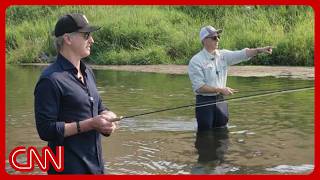
Gavin Newsom
gavin newsom threads the needle between progressive promises and pragmatic governance while keeping california's economy in his sightlines
Gavin Christopher Newsom (born October 10, 1967) is an American politician and businessman serving as the governor of California since 2019. A member of the Democratic Party, he served as the lieutenant governor of California from 2011 to 2019 and as the mayor of San Francisco from 2004 to 2011. Born and raised in S… wikipedia →
12-month trajectory
interviews & talks
recent news
education and student support
- California sends FREE life-saving asthma inhalers to ALL schools - California State Portal | CA.gov
- Gavin Newsom dodges SAT question as 1000+ UC professors warn college students can’t do basic math - New York Post
- RAW: CA: GOVERNOR NEWSOM EDUCATION REFORMS - Local 3 News
+ 4 more
clean energy infrastructure
- California Governor's $95M Plan to Expand EV Charging and Hydrogen Fueling - renewableenergymagazine.com
- Antonio Villaraigosa mends fences - Politico
- California announces $95 million investment for EV infrastructure expansion - EV Infrastructure News
+ 2 more
wildfire recovery and liability
- Paradise, California, leader says utility group ‘duped’ him to appear in wildfire ad - E&E News by POLITICO
- Gov. Newsom isn't backing down from push to limit how much utilities pay when they cause a wildfire - KCRA
- California drivers, business owners ‘in hell’ over new tire regulations - New York Post
+ 5 more
judicial and labor appointments
- Gov. Newsom Nominates 3 Black Women Judges to Serve on State Courts of Appeal - BlackPressUSA
- Governor Newsom announces appointments 8.19.26 - California State Portal | CA.gov
- Calif. To Let Some Local Jurisdictions Impose Higher Taxes - Law360
+ 1 more
high-speed rail project
- California’s midterm election could shape national political conflicts | Dan Walters - Santa Maria Times
- California special interest groups follow Newsom into early 2028 primary states - Washington Examiner
- Governor Newsom secures federal disaster assistance for small businesses impacted by Boyle Heights warehouse fire - California State Portal | CA.gov
nuclear energy policy
- Sean Duffy Touts $5 Billion Rail Investment, Slams Gavin Newsom’s High-Speed Rail Project: ‘Wasting Billions of Dollars…’ - Yahoo
- Gavin Newsom's Democratic Presidential Nomination Prospects Sink as AOC Emerges as Frontrunner on Crypto Prediction Market - Yahoo Finance
- “Sickle Cell Warriors” Urge Gov. Newsom to Sustain Critical Patient-Care Funding - The San Diego Voice & Viewpoint
political ambitions and criticism
- Opinion: Gov. Newsom and America should want more trillionaires - San Diego Union-Tribune
- President Trump’s AI Chat With Dead George Washington Sparks New Call for His Removal - Yahoo
- Xavier Becerra gets to play it safe in the race for governor, and he isn’t making promises - CalMatters
+ 7 more
utility costs and regulations
disaster aid and relief
law enforcement and crime
healthcare policy
doj investigation
government transparency
community events
climate policy criticism
dispatch
California's Governor Shapes AI's Legal Future
Gavin Newsom is California's governor and the most-watched Democratic prospect for 2028, and he now sits at the center of American AI policy: he vetoed one frontier-AI bill, signed a narrower one, and is fighting the Trump White House over whether states get to regulate AI at all. For a CTO, the signal is that AI governance has moved from voluntary safety blog posts to statute — with compute thresholds, mandatory transparency reports, and incident-reporting deadlines that look a lot like breach notification. Watch the state-by-state patchwork and the federal preemption fight, because they will decide what your compliance surface looks like.
Gavin Newsom's first real business was a wine shop. In 1992, in his mid-twenties, he opened a store in San Francisco called PlumpJack, with money from the billionaire Gordon Getty, a family friend. It worked. Over the next decade it grew into a small empire — something like two dozen businesses, wineries and restaurants and hotels, all run by a young man who was very good at standing in a room and making people feel like the future was arriving and he was holding the door.
That's the through-line, if you want one early. Newsom has always been the guy standing next to the new thing, pointing at it.
His path into politics was less about ideology than proximity. San Francisco's mayor at the time, Willie Brown, appointed him to a parking and traffic commission in 1996, then to a seat on the Board of Supervisors. Newsom won that seat outright in 1998. And in 2003, at thirty-six, he ran for mayor of San Francisco and won, beating a Green Party candidate named Matt Gonzalez in a runoff that the city's left never quite forgave him for.
Then came the moment that made him national. Within weeks of taking office, in early 2004, Newsom ordered the city to start issuing marriage licenses to same-sex couples. Thousands of people lined up outside City Hall. It was legally shaky, and the California Supreme Court voided those marriages later that year. But politically, it fixed him in the public mind as someone willing to get out ahead of his own party and dare it to catch up.
He kept climbing. Lieutenant governor in 2010. And here's the detail that matters for this audience: in 2013 he wrote a book called Citizenville, which was basically an argument that government should steal its playbook from Silicon Valley — open data, apps, platforms, treat citizens like users. This is a politician who has been fluent in tech-industry language for a long time, and who governs the one state that actually contains Silicon Valley.
He became governor in 2019 and was reelected in 2022. In between, he survived a recall election in 2021, fueled partly by anger at pandemic lockdowns and by a now-infamous dinner he attended, unmasked, at a very expensive restaurant while telling everyone else to stay home. And in 2025 he did the very modern thing of starting his own podcast, where he's interviewed people across the political spectrum, including some of his sharpest opponents.
So that's the man. A salesman turned mayor turned governor, comfortable in front of a camera, comfortable around founders, and — this is the part that has him on the index right now — increasingly the single most consequential politician in the country when it comes to artificial intelligence.
Let me put him inside the actual news.
Newsom is the most-watched Democratic name for 2028. Nobody seriously pretends otherwise anymore. And over the last two years he has quietly turned himself into America's referee on AI — the person deciding what the industry can and can't be made to do, in the state where most of it is built.
That referee role is contested from two directions at once, and both are live this week.
From above, there's Washington. In July of 2025, the Trump White House released what it called an AI Action Plan. It was crafted with heavy input from David Sacks, the venture capitalist Trump named as his AI and crypto czar, and it won quick applause from industry figures including OpenAI's Sam Altman. The plan's whole posture is acceleration — build data centers, cut guardrails, keep America ahead of China. And it carried a threat aimed straight at Sacramento: states that pass AI lams Washington considers "unduly restrictive" could see federal funding withheld. Newsom's press office called that threat, in a public post, "disgusting."
From below, there's the ordinary chaos of governing. This very week, as we're recording, one of Newsom's signature promises is back in the news for the wrong reasons — the California high-speed rail project. And his office recently announced that the state's minimum wage will rise to seventeen dollars and forty cents an hour in 2027, which California bills as the highest of any state. Reporting also suggests he's been pressing behind the scenes on a state antitrust fight over the Paramount–Warner Bros. merger. He is, in other words, doing the full governor's job in public while running a shadow presidential campaign.
But the reason a technical audience should care is the AI fight. So let's go under the hood, because the details are genuinely interesting, and they've been reported in ways that are easy to get wrong.
Start with the deepfake laws, because that's where Newsom started, and where he's been losing.
In September of 2024, Newsom signed a stack of bills aimed at AI in elections. He did it partly on stage at Salesforce's Dreamforce conference, signing pages while the CEO Marc Benioff interviewed him — political theater, but the bills were real. Two of them matter here. One, known as AB 2839, let people sue over deceptive, AI-altered political content in the run-up to an election. Another, called the Defending Democracy from Deepfake Deception Act, required large online platforms to block or label materially deceptive election content during certain windows.
Both got knocked down in court, and the reasons are worth understanding, because they're not partisan technicalities. They go to the hard architecture of American internet law.
The first law, the one letting people sue over altered political media, was blocked within weeks on First Amendment grounds. The judge described it as, in his words, "a blunt tool that hinders humorous expression" — meaning that if you write a rule broad enough to catch a malicious deepfake, you catch parody and satire in the same net, and the Constitution protects the parody.
The second law died on a different rock. In August of 2025, a federal judge struck it down by pointing at Section 230 of the Communications Decency Act — that 1996 statute that says online platforms generally aren't liable for what their users post. California had tried to make the platforms responsible for removing deceptive election content. Section 230 says, in effect, you can't do that. And the challenge that produced this ruling came from Elon Musk's company X, after Musk himself had shared an AI-altered video of Kamala Harris.
Sit with that for a second, because it's the whole problem in miniature. The technology to fake a candidate's face and voice is now trivial. The legal machinery to stop it runs straight into two of the strongest protections in American law — free speech and platform immunity. Newsom keeps writing laws, and the courts keep handing them back.
Now, why is the faking so easy? This is the part worth being precise about. Modern synthetic video mostly comes out of generative models — diffusion models for images and video, neural voice cloning for audio. A diffusion model learns by taking real images, adding noise until they're static, and training a network to reverse that process step by step. Do that across billions of images and the model learns the deep structure of faces, light, and motion well enough to generate new ones from a text prompt or a few seconds of reference footage. Voice cloning works on a similar principle for sound. The result is that a convincing fake no longer needs a visual-effects team. It needs a consumer GPU and a weekend.
Hany Farid, the Berkeley professor who has spent years building deepfake detection tools, put the trend plainly. He said the tech is "just getting really, really good," and he warned that in politics, "you'd be foolish to unilaterally disarm." Meaning: once one campaign starts generating this stuff, every campaign will. Reporting suggests 2026 may be the first election cycle where AI-generated content is simply everywhere — one congressional candidate already put out a slick fake video of his opponent, with the only disclosure buried in fine print at the end.
And detection, for what it's worth, is a losing arms race on its own. Every detector you train becomes training data for the next generator that evades it. That's why serious people have shifted from "can we detect fakes" to "can we prove what's real" — provenance and watermarking, cryptographically signing content at the moment of capture so authenticity travels with the file. It's a better idea. It's also nowhere near universal deployment.
Here's the twist that makes Newsom interesting rather than just another politician yelling about deepfakes. He is not anti-AI. Not remotely. He stood at Google's San Francisco campus and announced deals to put free AI tools into California schools, talking up, in his words, a "spirit of acceleration." He posts AI-generated memes mocking Trump on his own feeds. He wants the industry's money and its future in his state. So his real project isn't to stop AI. It's to find the narrow band where he can regulate it without the industry turning on him.
That project has a name now, and it's the most important thing he's signed. It's called SB 53.
Here's the backstory, because the sequence tells you how his mind works. In 2024, the same state senator, Scott Wiener, sent Newsom a much more aggressive bill, SB 1047. That one tried to make AI developers legally liable for catastrophic harms. It required a full-shutdown capability — a "kill switch" — for covered models. It required safety protocols before training even began, third-party audits, fast incident reporting, and penalties tied to the cost of the compute used to train the model. The industry revolted. Meta opposed it. The venture capitalist Ron Conway opposed it. Y Combinator's Garry Tan and roughly a hundred and fifty tech executives signed an open letter saying it would "gravely harm" California's lead in AI. And Newsom vetoed it, saying the state had to, in his words, "get this right."
Then he did something shrewd. He convened a working group of AI researchers to tell him what defensible regulation would actually look like. They reported back in June of 2025. And Wiener rewrote the bill around that report. The new version, SB 53 — the Transparency in Frontier Artificial Intelligence Act — passed the state senate with a bipartisan vote of thirty-seven to nothing, and Newsom signed it on September 29th, 2025. It's the first law in the country aimed specifically at frontier AI. Wiener described the shift in one line: it's not a liability bill, it's a transparency bill.
So what does it actually do? This is where the engineering-minded listener should lean in, because the drafting is careful.
First, it defines what it's regulating using compute. A "frontier model," under the law, is one trained with more than ten to the twenty-sixth power computing operations — counting the original training plus later fine-tuning.
If that number means nothing to you, that's fine. Hold onto one idea: it's a line drawn so high that only a handful of the very largest models on earth cross it today. This is a deliberate choice. Rather than regulate "AI" — an impossible category — the law regulates a specific, measurable, resource-defined tier of model. It scopes by physics.
Then it splits the companies. Any outfit that trains a model over that line is a "frontier developer." A "large frontier developer" is one with annual revenue above five hundred million dollars — that's the tier that carries the heaviest obligations, so the rules bite the biggest players hardest and leave the small labs lighter.
And it defines the thing it's actually afraid of: catastrophic risk. The law is narrow here, and specific. It means a foreseeable risk that a model materially contributes to an event killing or seriously injuring fifty or more people, or causing at least a billion dollars in damage. It also names a few concrete nightmares — a model giving expert-level help to build a chemical, biological, or nuclear weapon; a model carrying out a cyberattack or crime with no meaningful human in the loop; or a model slipping the control of the people running it.
That last category is the one that separates this from ordinary product regulation. The law contemplates, in statute, a model evading its own developer. Whatever you think of the probability, the state of California has now written loss-of-control into law.
Given all that, the obligations are almost boring, and that's the point. Large developers have to publish a framework describing how they identify and manage these catastrophic risks. Before deploying a frontier model, developers have to publish a transparency report — what the model is, what it's for, what the risk assessments found. They have to report critical safety incidents to the state's Office of Emergency Services within fifteen days, and within twenty-four hours if there's imminent danger to human life. And they have to protect whistleblowers — the engineers inside these labs who see something and want to say so without losing their jobs.
Notice what's not in there anymore. No kill-switch mandate. No pre-training gate. No liability for the harm itself. The enforcement is civil penalties, capped at a million dollars per violation, brought by the attorney general. Compared to the bill he vetoed, this is a featherweight. It doesn't tell you how to build. It tells you to show your work, report your accidents, and don't punish the people who raise their hand.
That's the whole design philosophy, and it's why it survived where the deepfake laws didn't. Transparency and disclosure are on much firmer legal ground than telling a platform what speech to remove.
So let me pull this back to what it means for you — the people building and buying this technology, not just watching the politics.
The first thing to take is that AI governance just crossed a line from voluntary to statutory, and it did it in the place that matters. For two years the safety conversation lived in company blog posts and model cards — voluntary commitments a lab could revise or quietly drop. California just converted a chunk of that into law, with definitions, deadlines, and an attorney general attached. If you're a CTO at a large model developer, your safety framework and your transparency report are no longer marketing. They're filings.
Second, the structure of this law is the template to plan around, not the specific numbers. Watch the pattern: scope by compute, tier by revenue, mandate disclosure, require incident reporting on a clock. New York has a similar frontier-AI bill moving. Other states are drafting. If you're building compliance, don't hard-code today's thresholds. Build the capability to answer three questions on demand — how much compute went into this model, what did our risk assessment find, and what's our process when something goes wrong. Those questions are going to be asked by more than one government.
Third, and this is the practical one for security and platform teams: treat AI incident reporting like breach notification, because that's what it now is. Fifteen days for a critical safety incident, twenty-four hours if lives are at imminent risk. If you've built the muscle for data-breach disclosure, you know this shape — you need detection, an internal escalation path, and a legal-and-comms process that can move in a day, not a quarter. Most AI organizations do not have that today. The ones that build it now will not be scrambling later.
Fourth, the whistleblower piece is going to change internal culture whether you like it or not. The law assumes the people most likely to spot a catastrophic risk are your own engineers, and it protects them for speaking up. If your org treats safety concerns as disloyalty, the law is now on the side of the engineer. Build the anonymous channel before you're required to, and actually listen to it.
Fifth — the deepfake reality. Even though the specific laws got struck down, the underlying threat is aimed at every brand, not just candidates. Synthetic audio of your CEO authorizing a wire transfer is not a hypothetical; voice-clone fraud is here. The defensive posture is shifting from detection, which is a losing arms race, toward provenance — signing your real content so it can be verified. If you produce anything where authenticity matters, start looking at content-provenance standards now, because the tooling is maturing and your customers will expect it.
And then there's the federal collision, which is the biggest strategic unknown on the board. Washington wants to preempt state AI rules and has floated withholding funds from states that regulate too hard. California is pushing the other way. For a CTO, that means the compliance map for the next few years is genuinely uncertain — you could face a strict patchwork of state laws, or a loose federal ceiling that wipes them out, and nobody can tell you which yet. The correct response to that uncertainty isn't to bet on one outcome. It's to build for optionality — keep your governance modular so you can dial it up or down as the law settles, and budget for the fact that "we'll figure out compliance later" is getting more expensive every quarter.
I want to end on the story that's in the news this exact week, because it's a warning that has nothing to do with AI and everything to do with how you should read Gavin Newsom.
California's high-speed rail. Voters approved it back in 2008 — bullet trains between San Francisco and Los Angeles, the whole trip in under three hours at two hundred and twenty miles an hour. It was going to be the future. This summer the Trump administration pulled four billion dollars in federal funding, pointing out that the state had spent something like fifteen billion dollars over sixteen years without laying finished track. The transportation secretary, Sean Duffy, said federal dollars, quote, "are not a blank check." Newsom called it a political stunt to punish California, and the state sued.
And then, at the end of 2025, California quietly dropped the lawsuit. This week a CBS investigation dug into why, and found something uncomfortable: the state had missed its own deadline to even buy the trains, a deadline written into the federal grant. The grand plan has shrunk to a stretch in the Central Valley — Merced to Bakersfield, a hundred and seventy-one miles — with service maybe starting in 2033.
Here's why that belongs in a conversation about AI. Newsom is a superb announcer of futures. He stands next to the new thing and points. Sometimes the thing gets built, and sometimes the press release is the product. SB 53 is real and well-drafted — genuinely so. But the test of any of this, the AI rules included, isn't the signing ceremony at Google's campus. It's whether the incident reports actually get filed, whether the transparency reports actually say anything, whether the enforcement ever happens.
So watch what he signs. But if you're deciding where to put your own time and budget, judge this the way you'd judge a vendor roadmap. Not by the demo. By what ships. The high-speed rail is the reminder that in California, and in AI, the distance between the announcement and the finished track is exactly where all the real work lives.
sources (78)
- https://sfstandard.com/2025/07/25/gavin-newsom-ai-regulation-president-donald-trump/
- New California laws cracking down on AI election deepfakes face legal challenges - CBS San Francisco
- Calif. Governor Newsom signs laws to crack down on election deepfakes created by AI - ABC7 San Francisco
- As Trump moves to decimate state AI laws, Governor Newsom taps the nation’s top experts for groundbreaking AI report | Governor of California
- California Tackles AI Election Deepfakes - Newsweek
- Sep 17, 2024
- https://www.ischool.berkeley.edu/news/2025/san-francisco-chronicle-covers-newsoms-use-ai-post-trump-memes-hany-farid-reacts
- democrats dig in with a new type of campaign against trump
- Democratic Gov. Gavin Newsom of California says he'll consider presidential run after 2026 midterms
- 'Wake up' America, Gavin Newsom says, warning that Donald Trump wants third term in office
- https://www.cbsnews.com/news/california-high-speed-rail-train-procurement-newsom/
- High-Speed Rail seeks $396M federal grant after Trump administration pulled $4B
- California drops lawsuit over $4 billion high-speed rail funding withdrawal | Fox Business
- California drops lawsuit over high-speed rail funding, moves forward without federal support | cbs8.com
- California drops lawsuit seeking to reinstate federal funding for high-speed rail project | PBS News
- After 25 Years and Billions in Federal Subsidies, not a Single Train Operating in California - U.S. Senate Committee on Commerce, Science, & Transportation
- Trump terminates federal funding for California’s $135B high-speed rail ‘boondoggle’: ‘TRAIN TO NOWHERE’
- President Trump announced no federal funding for CA high-speed rail project
- U.S. seeks return of $2.5 billion California high-speed rail funds
- California's minimum wage to rise to $17.40 in 2027, Governor Newsom announces | abc10.com
- Minimum wages set to increase in 2027: $17.40 an hour | KTVU FOX 2
- With 2027 minimum wage increase, Newsom says CA puts 'working families first' - ABC7 Los Angeles
- Governor Gavin Newsom announces raise of California minimum wage to become highest statewide rate in the nation
- California minimum wage will rise to $17.40 in 2027, higher than any current statewide rate in the U.S. - CBS Sacramento
- California minimum wage to increase to $17.40 an hour in 2027, Newsom announces
- California to Raise Minimum Wage to $17.40 in 2027 | The Epoch Times
- California minimum wage will rise again in 2027. Here’s the new rate | KTLA
- Governor Newsom announces California will raise statewide minimum wage | Governor of California
- May 12, 2022 - Politics & Policy
- AI Is Remaking Election Speech. That’s Not Necessarily a Bad Thing. | Cato at Liberty Blog
- Calif. Governor Newsom signs laws to crack down on election deepfakes created by AI | abc7news.com
- newsom has strong fear son b trump suspend 2028 presidential election
- Gavin Newsom fears there won’t be a presidential election in 2028
- AI deepfakes blur reality in 2026 U.S. midterm campaigns
- https://www.conference-board.org/research/CED-Newsletters-Alerts/federal-judge-strikes-down-california-deepfake-law
- AI deepfakes are part of the 2024 election. Will the federal government regulate them?
- Deepfakes getting deeper in the run-up to 2024’s election
- California Moves to Regulate Frontier AI With a Focus on Catastrophic Risk | Insights & Resources | Goodwin
- https://fpf.org/blog/californias-sb-53-the-first-frontier-ai-law-explained/
- At the Frontier – California Enacts AI Safety and Transparency Regulation TFAIA (SB 53) | Morrison Foerster
- SB 53: What California’s New AI Safety Law Means for Developers - Wharton AI & Analytics Initiative
- California Enacts Major AI Safety Legislation for Frontier AI Developers | Wilson Sonsini
- Transparency in Frontier Artificial Intelligence Act (SB-53): California Requires New Standardized AI Safety Disclosures
- California Just Passed the First U.S. Frontier AI Law. Here’s What It Does. | Carnegie Endowment for International Peace
- News & Analysis as of
- Sep 29, 2025
- California withdraws lawsuit challenging Trump’s $4 billion high-speed rail funding cut
- los angeles times trump administration sees no viable path forward finish high
- California drops lawsuit over Trump decision to pull $4 billion in high-speed rail funds
- Free Trial
- Trump administration may rescind $4 billion for California High-Speed Rail project
- AI deepfakes blur reality in 2026 U.S. midterm campaigns | Honolulu Star-Advertiser
- How Trump’s AI deepfakes fit perfectly into his ‘flood the zone’ disinfo strategy
- Newsom has touted AI’s lofty potential. Now he’s using it to post a stream of Trump memes - Media Coverage - Stanford Law School
- Newsom signs election 'deepfake' ban, Musk claps back resharing AI-altered video of Kamala Harris
- Deepfakes in the 2024 US Presidential Election
- 2024 04 16 pm qfr responses gupta
- The Firing Line
- Federal Judge Strikes Down California Deepfake Law
- Federal judge strikes down California law targeting misinformation | The Free Speech Project
- MediaDailyNews: California Deep Fake Law Struck Down
- Judge strikes down California deepfake law as unconstitutional
- Federal Judge Strikes Down California’s Deepfake Law
- Federal Judge Strikes Down California's Unconstitutional Deepfake Law | ZeroHedge
- California Law Restricting "Materially Deceptive" Election-Related Deepfakes Violates First Amendment
- Judge to say CA can’t enforce online ‘deepfake’ ban law | Northern California Record | legalnewsline.com
- cointelegraph:9655167fc094b:0 judge finds new california election deepfake ban unconstitutional
- Gavin Newsom Reportedly Concerned About State Antitrust Suit Against Paramount-Warner Bros. Merger
- Progressives Rip Newsom Over Reported Meddling in Suit Against Paramount-Warner Merger | Common Dreams
- California Gov. Gavin Newsom Encourages State AGs to Settle Paramount-Warner Bros. Merger Lawsuit | Report
- WBD Stock Posts Best Day In Nearly 8 Months — Newsom Reportedly Seeks Out-Of-Court Resolution In Paramount Antitrust Suit
- Newsom Grows Antitrust War Chest As California Mulls Paramount-WBD Merger
- California's Governor Wants To Settle Its Lawsuit Against Paramount As Newsom is Worried About the Negative Impacts on Jobs in The State | Cord Cutters News
- Newsom Tells Bonta To Make A Deal: California Governor Pushing To Settle Paramount-Warner Bros. Lawsuit - Cosmic Book News
- California And 11 Other States Sue To Block Paramount-Warner Bros. Discovery Merger
- California attorney general vows to scrutinize Paramount's deal for Warner Bros. Discovery
- https://www.ischool.berkeley.edu/news/2025/2026-may-be-first-election-where-artificially-generated-content-inescapable-hany-farid